|
| .. |
| world's
first SSDs for use in Intel PCs |
In 1982 - SemiDisk Systems (based in
Beaverton Oregon) became the first company to ship SSD accelerators for the
Intel microprocessor based PC market.
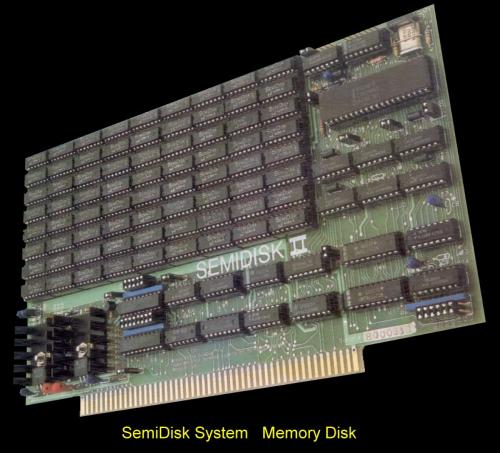
SemiDisk's first disk emulator
cards were S-100 form factor RAM SSDs with 512 kilobytes capacity which cost
$1,995 price at launch - which was equivalent to 2 months average
wages at that time.
Internally they used 64Kb DRAM, worked via a proprietary interface - and were
designed to work with
S-100 computers (which had Z80 8
bit CPUs inside with a 64 kilobytes addressible bus). |
 |
Soon after, SemiDisk built
similar cards for TRS-80 Model II computers, and IBM PC's, and Epson QX-10
computers, and increased the capacity to 2 megabytes when 256Kb DRAM became
available.
SemiDisk's founder - Jim Bell - told me (in 2014)
"the R/W throughput of these SSDs was limited by the Z-80 block transfer
function speed. (INIR, OTIR) So it was about 500 kilobytes/second speed. But
that was considered VERY fast in the early 1980's... Speed was always the main
benefit (and reason for buying)... It was mostly consumers and businesses who
bought it."
Jim also said "One notable feature of these
cards is that they 'carpeted' the card with memory sockets that were literally
as close together as it was possible to push them! They used 'dipguard' type
decoupling capacitors, too."
Jim said he designed the prototype
of the SemiDisk in "about October 1980" - when he was working for
Intel in Aloha Oregon. He went on to say - "I built a device on a
wirewrap, prototype card, using 2118 5-volt 16kbit DRAMs. It had 32 sockets,
and I installed the chips 8-high. (Looked like a brick!; heavy, too,
because the chips were ceramic, specifically 'cerdip' devices.)"
SSD Market
History | | |
| ..... |
|
| |
 |
| .. |
|
by Zsolt
Kerekes, editor, StorageSearch.com
|
If you want to learn
more about SSDs for your own personal use or because you run your own small
business - then this page is for you.
It lists consumer SSD related articles and directories - both here
on StorageSearch.com and external sites which readers have recommended to me
(in the tables on the right of this page). And just as important - these links
will steer you clear away from the complex mission critical SSD content on
StorageSearch.com which is intended for people who need to know more about
SSDs as part of how they make their living.
When did the consumer
SSD market begin?
Throughout most of
SSD market
history high capacity SSDs (with capacity comparable to big
hard drives)
cost more than the
average person's car or home. That's why the consumer SSD market started
long after the
industrial,
military and
enterprise SSD
markets.
If I had to pick a year from which to date the start of the
consumer SSD market (as we know it today) - it would be 2006.
That's when awareness of
true SSDs
(as opposed to USB flash memory
sticks) flared into the notebook market and the first notebook PCs with
genuine SSDs instead of hard drives became generally available (to those who
could afford them).
Obviously
SSD market analysts
like me were writing about the (then) "future" consumer SSD market a
year or so before that time - and enterprising individuals were setting up SSD
business units and founding companies to design products for the consumer SSD
market from around 2004 / 5.
How good are consumer SSDs?
You
won't find anyone more enthusiastic about solid state storage than me. But -
here's an important sanity check.
Even the very best consumer SSDs
available today are vastly inferior in
performance and
reliability to the
best SSDs in the enterprise
and industrial
markets.
I'm not trying to put you off. I'm just stating a fact.
In
that case - you may well ask - what's so great about consumer SSDs?
Well
- if SSDs cost the same as
hard drives then nobody
would buy the hard drives unless they were going to rip them apart to use as
artwork (I have seen it done and encourage you to destroy your old HDDs too as a
cheap form of disk
sanitization) or unless they intended to use the HDDs in a nostalgic
computer restoration project, or as a working exhibit in a computer museum.
The
reasons for using SSDs in the consumer world today are the same as they've
always been - and were part of the
value
propositions which gave birth to the entire market concept.
Consumer
SSDs can provide a superior user experience or enable the product designer
to do things which were previously technically impossible. Here are some
examples of what you can do with the best consumer SSDs compared to the best
HDDs.
- SSDs are much faster - when booting and in complex operations like games
and creating video or presentations
- SSDs use less power - longer battery life, less heat on your lap and less
need for noisy fans
- SSDs can fit into smaller physical spaces
That's it for now.
I hope you find the
links on this page useful. | |
| .. |
 | |
 |
. |
Megabyte's internationally
famous reputation for making cool calm rational judgments was
momentarily at risk of being blown away | |
| .. |
|
|
| . |
|
|
| . |
|
|
| .. |
|
| |