|
|
| ..... |
SSD history is a mess.
I know I was there and I wrote the first draft of it.
But
there is an easy way to get the lessons of all that history of technical change
and market adoption by looking at 4 strategic before and after events. |
| strategic
bifurcations in SSD market history | | |
| ..... |
by
Zsolt Kerekes
- editor StorageSearch.com
There's
one kind of market research report which you won't find listed on the website
of any storage market report vendor - and that's a directory of all the other
market research companies they compete with! Here's my list - compiled from
over 20 years of
past news
stories - which includes all categories of market research companies... |
- Storage Clairvoyants - predict the future
- Terabyte Talliers - tell you what's already happened
- Storage SoothSayers - make your
PR sound more
credible...
|
|
|
. |
 |
. |
| Who are the top SSD
companies? ... the companies which you absolutely have to look at if you've got
any new projects involving SSDs? |
| the Top SSD Companies | | |
. |
 |
|
|
.
. |
 |
| |
 |
| ..... |
news about storage market trends |
what happened in SSD Year
2018?
Editor:- November 11, 2018 - there's a new article on StorageSearch.com -
SSD Year 2018
- 3 things which have already happened and 1 which hasn't (yet). ...read the article
DRAMeXchange says - supercycle of DRAM price hikes is over
Editor:-
October 9, 2018 -
DRAMeXchange today
reported
how it's interpreting memory pricing and supply trends.
Re DRAM
- DRAMeXchange says:-
- DRAM products have begun to see a weak price trend, showing only a 1~2% QoQ
hike in contract prices for 3Q18 due to the continued oversupply, despite the
coming of holiday sales season. DRAMeXchange expects the quotations of DRAM
products to decline by 5% or more QoQ in 4Q18, terminating the super cycle of
price growth for 9 consecutive quarters.
- DRAM manufacturers all expect a high possibility of oversupply in 2019.
Therefore, they have tried to postpone or slowdown the capital expenditure and
capacity expansion.
- For 2019, DRAMeXchange expects the annual bit output to increase by nearly
22%.
re nand flash - DRAMeXchange says:-
- nand flash experienced a price drop of around 10% in 3Q18 and expects a
steeper drop of 10~15% in the fourth quarter, considering the impacts of trade
war. Contract prices of 3D TLC NAND Flash chips in the channel market may even
drop by more than 15% in 4Q18.
- The nand flash market is influenced by the sluggish demand for consumer
electronics, while demand for the more profitable Enterprise SSD from servers
and data centers remains stable. However, the competition among Enterprise SSD
suppliers will become increasingly fierce; hence the prices of Enterprise SSD
are very likely to continue decreasing in 2019.
- On the supply side, nand flash suppliers have raised their output forecasts
as they have expanded their production capacity and improved the yield rates of
their 64/72-layer 3D NAND production.
See also:- storage
market research directory
Clarifying SSD Pricing
- where does all the money go?
a simple
guide to semiconductor memory boom-bust cycles
2 new reports on the SSD market
Editor:- September
30, 2018 - Forward Insights
has published 2 new reports related to the SSD market:-
China's Solid State
Drive Market , and Storage
Class Memories.
new Digital Storage for Media and Entertainment Report
Editor:- August 27, 2018 - Coughlin Associates
today announced the availability of its new (14th annual)
Digital
Storage for Media and Entertainment Report - 2018 - (254 pages, $7,500).
Editor's
comments:- Among other things the press release about the new report includes
these interesting observations:-
- By our estimates, professional media and entertainment storage capacity
represents about 4.5% of total shipped storage capacity in 2017
- In 2017 we estimate that 71% of the total storage media capacity shipped
for all the digital entertainment content segments was in HDDs, with digital
tape at 22.7%, 4.3% optical discs and flash at 2.0%. Flash memory dominates
cameras and is finding wider use in post production and content distribution
systems.
- Overall cloud storage capacity for media and entertainment is expected to
grow about 13.3X between 2017 and 2023 (5.1 EB to 68.2 EB)
See
also:- a timeline of SSDs
in tv and media
new report lists malware attack vectors for memory in
processors
Editor:- June 14, 2018 -
Security
Issues for Processors with Memory is a new report (90 pages, $975) by Memory Strategies International
with ramifications (I had to use that word) for the memoryfication of processors
market.
The report includes a comprehensive list of the dimensions in
which security can be attacked and outline of design mitigation directions.
Among other things the scope includes:- "Issues of volatile
vs. non-volatile memory for cache and main memory involve consideration of
security hazards. Cryptography in multicore coprocessor systems are an issue.
Security of data on network buses is critical for military, medical and
financial systems with remedies suggested for replay attacks..." ...see more
about this report
See also:-
is data
remanence in persistent memory a new risk factor?,
optimizing
CPUs for use with SSD architectures,
SSD security,
PIM, in-situ processing
and other SSD jargon
DRAM market - update from IC Insights
Editor:- March
6, 2018 -
Are
the Major DRAM Suppliers Stunting DRAM Demand? asks the
2018 McClean
Report by IC Insights.
"In 2017, DRAM bit volume growth was 20%, half the 40% rate of increase
registered in 2016. For 2018, each of the 3 major DRAM producers (e.g.,
Samsung, SK Hynix, and Micron) have stated that they expect DRAM bit volume
growth to once again be about 20%. However monthly year-over-year DRAM bit
volume growth averaged only 13% over the 9-month period of May 2017 through
January 2018." ...read
the article
Nanya presents overview of the memory market
Editor:-
December 14, 2017 - An overview of the $120B (in 2017) memory market - which
consolidates data from various market research sources appears in a
Presentation
to Analysts and Investors (pdf) - published today by Nanya Technology .
In
2017 worldwide revenue of DRAM was approx $69B - up 67% YoY.
In 2018
worldwide wafer starts for DRAM will increase moderately to 1,210K/month.

AFA market revenue grew to $1.6B in 3Q17 - says Dell'Oro
Editor:-
December 6, 2017 - "AFA market revenue grew 33% yoy in 3Q17, reaching
$1.6 Billion" according to a new report -
Storage
Systems Quarterly - published by Dell'Oro
Group.
"All Flash Array is a very important technology
segment in external storage. In fact, as a percentage of external storage
revenue, it has been growing dramatically—from 22% in 3Q16 to 28% in 3Q17.
So every vendor is determined to expand their position in all-flash storage
systems" said Jimmy
Yu, VP at Dell'Oro Group.
Editor's comments:- Dell'Oro's press
release lists the 5 biggest vendors and the company can provide more analytical
data in their purchaseable reports.
PCIe SSDs (enterprise and notebook M.2) did well in Q3
Editor:-
November 15, 2017 - TrendFocus
today published
SSD
market shipment data for Q3 2017.
Only one segment, enterprise
PCIe, saw unit growth where every other segment – client drive format
factor, client modules, enterprise SATA and enterprise SAS, all declined from
the prior quarter.
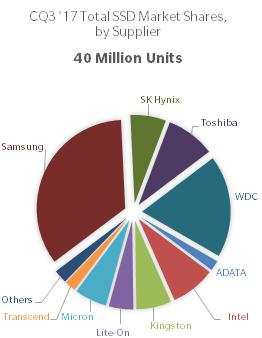 The
enterprise SSDs market declined 7% Q-Q, which includes
SATA,
SAS and
PCIe. The bright spot
within this overall decline was the healthy 15.6% increase in PCIe units. As
hyperscale companies continue to migrate away from SATA, PCIe should continue to
grow in both units and exabytes. SATA, still the highest volume of all
enterprise categories, managed to stay just above 4 million units shipped but
did decline sharply in CQ3. However, exabytes shipped in the SATA SSD market
grew due to the transition to higher capacity units. SAS SSDs now represent the
lowest unit volume of the enterprise SSD segments, but still maintain a large
lead in average capacity shipped at over 2.1 terabytes. The
enterprise SSDs market declined 7% Q-Q, which includes
SATA,
SAS and
PCIe. The bright spot
within this overall decline was the healthy 15.6% increase in PCIe units. As
hyperscale companies continue to migrate away from SATA, PCIe should continue to
grow in both units and exabytes. SATA, still the highest volume of all
enterprise categories, managed to stay just above 4 million units shipped but
did decline sharply in CQ3. However, exabytes shipped in the SATA SSD market
grew due to the transition to higher capacity units. SAS SSDs now represent the
lowest unit volume of the enterprise SSD segments, but still maintain a large
lead in average capacity shipped at over 2.1 terabytes.
Client SSD
shipments fell 4.5% sequentially but exabytes shipped was flat. Client modules
now represent almost 2/3 of all client SSDs shipped. Even more impressive within
this segment is that M.2
PCIe is now 50% of this segment – illustrating the continued migration for
major Notebook
OEMs to integrate with this interface.
3D NAND accounted for more than
50% of all bits shipped for the first time in CQ3, as all of the NAND suppliers
are well into the transition.
new report sizes NVDIMM market at 12 million units in 2021
Editor:-
October 19, 2017 - October 22, 2017 - Objective Analysis
opined today that the market for NVDIMMs is poised to grow at a 105% average
annual rate to nearly 12 million units by 2021.
This forecast is a part of the company's new 80-page report titled -
Profiting
from the NVDIMM Market (outline pdf), single user price
$6,500
- which among other things predicts unit and revenue shipments through 2021.
See also:- hybrid
DIMMs - market timeline,
Memory Channel
SSDs, market research
- storage
hyperscale is nearly 1/4 of all enterprise storage revenue
Editor:-
September 14, 2017 - A new
report
from IDC confirms
the growing size of the enterprise storage systems market related to
hyperscale datacenters. Sales by ODMs to the hyperscale segment grew 73.5%
year over year to $2.5 billion in in the 2nd quarter 2017 to reach nearly a
quarter of the entire $10.8 billion in all segments.
Editor's
comments:- 5 years ago in my article -
the big market impact
of SSD dark matter - I wrote about the future importance of web scale and
cloud companies to the development of the enterprise SSD market. These users
have been leading the curve in mainstream storage and memory architecture
adoption because they get immediate cost. benefits from
efficiency oriented
designs.
These changes in
storage
market segmentation have also encouraged new
rackmount SSD
vendors to nurture significant business ambitions with unbloated lean product
catalogs while ignoring traditional (declining) legacy markets.
miscellaneous consequences of the 2017 memory shortages
Editor:
- September 7, 2017 - This has been a year like no other in the 40 year
SSD market
experience. In a new blog on StorageSearch.com
- miscellaneous consequences of the
2017 memory shortages - I look at the pain points and share with you my
analysis of where I think the big fixes to the memoryfication market
challenges will come from. The time lag for a market fix can be understood
better if you appreciate that the speediest mitigation won't come from the
wafer fabs. ...read the article
among the awards at FMS
Editor:- August 11, 2017 -
With so many things going on in the SSD and memoryfication markets the
best
of show award winners category at the annual Flash Memory Summit has - in
past years - provided a useful way to filter interesting developments. And
this year is no exception. Among the many awards - 2 things caught my
attention:-
- IO Determinism - won an award for Toshiba and Facebook.
Although by no means a new virtue within benchmarking nevertheless the
recent award has refreshed the idea with a new spin. read
more about it
You might say that what the 2 different awards
above share in common is the desire for predictability in environments
which are beset by highly chaotic elements.
IC Insights reports record breaking memory ASPs
Editor:-
July 20, 2017 - A recent
research
note about the memory market by IC
Insights puts an interesting spotlight on memory shipments.
Among
other things IC Insights says:- "DRAM, unit shipments are actually
forecast to show a decline this year. Moreover, NAND shipments are forecast to
increase only 2%."

When
it comes to price expectations IC Insights says this.
"Even
though DRAM ASP growth is forecast to slow in the second half of the year, the
annual DRAM ASP growth rate is still forecast to be 63%, which would be the
largest annual rise for DRAM ASPs dating back to 1993 when IC Insights first
started tracking this data. The previous record-high annual growth rate for
DRAM ASP was 57% in 1997. For NAND flash, the 2017 ASP is forecast to increase
33%, also a record high gain. (In the year 2000, the predominantly NOR-based
flash ASP jumped 52%).
For those who need much more information IC
Insights publishes a 250 page report ($4,090) which includes various free
monthly updates. ...read
more
Editor's comments:- One message to take away from this is
that as memories have been transitioning to the next multiple of 3D layers the
chip throughput from the industry's legacy wafer fabs has stayed the same or
gone backwards due to the extra time taken to reliably make those extra layers
to create higher bit density memories.
TrendFocus reports sequential decline in raw storage drive
capacity sold in Q1 2017
Editor:- May 16, 2017 - TrendFocus today
announced
market highlights related to storage drives in Q1 2017.
The number
of exabytes shipped in HDDs and SSDs fell sequentially by 5% but was 19%
higher than the year ago period.
TrendFocus says several factors
contributed to the decline:- including weak PC sales, cyclicality in data
center spending, and tight NAND supply affecting SSD buying patterns.
Re
delays in storage spending in data centers:- TrendFocus says...
"Some
large hyperscale/data
center companies purchased fewer HDDs and SSDs in the quarter, temporarily
slowing exabyte growth in the segment responsible for driving the highest
long-term rate of capacity demand."
Editor's comments:-
whereas higher prices of flash SSDs due to fab production capacity
constraints and lower than expected yields in new memories has undoubtedly
been a significant factor in the market - another thing to keep your eye on is
the potential for big users to get more use out of the same raw capacity by
using newer software.
That's a factor which can surprise the market
at any time as I discussed in my warning article about the
impact of the SSD
software event horizon.
Another long term trend which will depress
storage drive sales will be the refocus on
memoryfication
architectures.
I'm not going to attribute this 5% decline in
raw storage drive byte shipments to the adoption of new memory
architectures. It's probably just a correction with many causes.
But
looking ahead to the next several future years you should not be surprised to
the impacts on the storage drive market which could be much higher.
low yield at sub 20nm is root of DDR4 shortage says DRAMeXchange
Editor:-
April 14, 2017 - Quality problems in
DRAMs which have been
sampling this year at the new sub 20nm generation from major suppliers is at
the heart of the issues discussed in a new -
market
view blog by DRAMeXchange - which concludes that the contract prrice
of 4GB DDR4 DRAM modules will rise 12.5% entering 2Q17.
Avril Wu,
research director of DRAMeXchange said - "PC-OEMs that have been
negotiating their second-quarter memory contracts initially expected the market
supply to expand because Samsung
and Micron have
begun to produce on the 18nm and the 17nm processes, respectively. However both
Samsung and Micron have encountered setbacks related to sampling and yield, so
the supply situation remains tight..." ...read the
article
2017 will be crossover revenue year for DDR4 says IC Insights
Editor:-
April 13, 2017 - A new
report
about the DRAM market by
IC Insights
says:-
- DDR4 prices in 2016 fell to nearly the same ASP as DDR3 DRAMsAs a result,
IC Insights expects DDR4 to become the dominant DRAM generation in 2017 with 58%
market share versus 39% for DDR3.
- Following a year of extraordinary gains in pricing, a boost to DRAM supply
in the second half of 2017 could lead to reduced ASPs and the inevitable start
of a cyclical slowdown in the DRAM market.
...read
the article
Are we there yet?
Editor:- April 7, 2017 - After
more than 20 years of writing guides to the SSD and memory systems market I
admit in a new blog on
StorageSearch.com -
Are
we there yet? - that when I come to think about it candidly the SSD
industry and my publishing output are both still very much "under
construction". ...read
the article
NVMe market growth expectations
Editor:- March 31,
2017 - The state of the NVMe SSD and fabric market and its growth expectations
are conveniently summarized in a new presentation -
Experiences
with NVMe over Fabrics (pdf) - by Mellanox. Among other
things:-
- 40% of AFAs will be NVMe based by 2020
- shipments of NVMe SSDs will grow to 25+ million by 2020
- 740,000 NVMe over Fabrics adapters will be shipped by 2020
This
paper captures current expectations for how the market is expected to grow.
...read
the article (pdf)
Flash Memory Market $37 billion in 2016
Editor:-
March 29, 2017 - Revenue for the worldwide
flash memory market rose
10% year on year to about $37 billion in 2016 - according to a report by Web-Feet Research
which also says that the memory industry is in its first period of not being
able to supply enough products since the year 2000. ...more in SSD news
Fastest Growing Storage Companies in 2017?
Editor:-
March 25, 2017 - 3 SSD companies were among those listed in a new article -
10
Fastest Growing Storage Companies 2017 - by Silicon Review .
Editor's
comments:- all 3 companies operate in the
rackmount SSD market
- which is an interesting indicator of where the action is. There's still
everything to play for for as the market is still still
"under
construction".
Toshiba was fastest growing SSD vendor in 2016 says IDC
Editor:-
March 8, 2017 - The flash business unit of Toshiba - which may be
called something different depending when you read this - has
announced
that its SSD business
was the 4th largest by market share and the fastest growing (year on year) in
2016 according to data in a report -
Worldwide Solid
State Storage Quarterly Update, CY 4Q16 ($40,000) - published recently by
IDC.
who's well regarded in networked storage?
Editor:-
February 1, 2017, 2017 - IT Brand Pulse
today
announced
the results of its recent survey covering brand perceptions in the networked
storage market.
Among other things:- "By nearly a 2-to-1 margin,
Seagate, outperformed second-place challenger (Western Digital) to capture its
5th Market Leader award for Enterprise HDDs.)" ...read
the article
NVDIMM market report
Editor:- January 11, 2017 - The
NVDIMM market is estimated to grow at 64% CAGR over the course of 2016 to
2020 according to 9Dimen
Research who recently published a report
Global NVDIMM Industry
2016, Trends and Forecast Report ($2,850, 153 pages).
See
also:- hybrid
DIMMs market timeline,
memory channel
SSDs
BCC predicts $850 million market for carbon NRAM in 2023
Editor:-
December 9, 2016 - BCC Research
today
announced
a report -
is
NRAM Creating Market Volatility?
- which among other things - predicts the size of the NRAM market
based on technology developed by Nantero.
In
the preamble BCC says...
"Can you give us a small peek at why
NRAM will hold the advantage vs. Flash, SRAM and DRAM in the coming years? -
The key word is breakthrough. With NRAM we depart the world of silicon and
embrace cell phones, laptops and even an internet, that is increasingly going to
become carbon based organisms. Smaller components that work faster but require
less energy are absolute winners."
See also:-
flash and alt nvms
NVMdurance compiles list of flash memory forecasts
Editor:-
December 31, 2016 - How big is the flash market?
One company with a
particular interest in that is
NVMdurance
whose light runtime footprint
endurance
expanding firmware technology can be applied to almost any kind of
nand flash as an
alternative (or companion) to more heavy weight
controller derived
adaptation
techniques.
So if you're looking at flash market sizing data take a
look at NVMdurance's new
flash memory
forecasts page which lists headline numbers from an assortment of market
data sources.
Databeans expects growth in 2017 mil / aero semico market
Editor:-
November 16, 2016 - A new blog by Databeans -
a
Turn Around on the Horizon for Mil/Aero says it expects revenue for
semiconductors used in the military and aerospace market to grow by 8%
in 2017. ...read
the article
See also:-
military SSDs - news and
articles
SSDs outsell HDDs in European storage distribution channels
Editor:-
October 18, 2016 - "Revenues from sales of oem SSDs through Western
European distribution channels in September 2016 again exceeded revenues from
oem HDDs" - is the key message from a
research
note posted by Mehari
Goitom, Enterprise Account Manager - Context World.
Mehari
says - "This confirms SSDs as the leading storage technology in the
dedicated storage market for the 3rd calendar quarter as large enterprise
customers use them to replace HDDs." ...read
the article
New ingredients in the mix for storage market clairvoyants
Editor:-
July 20, 2016 - What do you predict will happen in the storage market in the
future? And how "real" are some of the newer technologies that you
read about in web pages like this?
As a technology publisher for over
20 years I've been fortunate to have my own advance signals like talking to
company founders, investors emails, web stats and inquiries about advertising
for future product lines. And I use those to guide my priorities within the
lanes that I write about.
Gerard Blokdijk
CEO of The Art of Service
(based in Brisbane Australia) has published a new market research report -
Storage
Technologies predictive analytics report ($97) which evaluates 36
storage-related hardware and software technologies in terms of their business
impact, adoption rate and maturity level to help users decide where and when to
invest.
"Data sources include trend data, employment data,
employee skills data, and signals like advertising spent, advertisers,
search-counts, instruction and courseware available activity, patents, and books
published."
Editor's comments:- As a publisher who has
helped to accelerate the adoption of new technologies by writing about them I
have often said that new technologies become real when you see them
advertised because
editorial, and trade show activity in the storage market often precedes by
3 to 5 years the general availability of innovative new products which
you can buy.
The Art of Service's inclusion of employment signals
and product ads into the analysis mix sounds like a useful methodology
difference compared to reports and trackers seen in this market before.
See also:- who does storage market
research?
enterprise PCIe SSD shipments grew 16% Q-Q
Editor:-
May 18, 2016 - TrendFocus
today announced
publication of its
Q1
2016 nand/SSD quarterly market report.
TrendFocus says the
enterprise SSD market saw growth in all segments -
SATA,
SAS, and
PCIe.

For
enterprise SATA SSDs, unit growth compared to the previous quarter was 5%,
while SAS and PCIe saw higher growth at
6.7% and 16.3%, respectively.
Editor's comments:-
In Q1 2016 SSD shipments reported by TrendFocus were 30 million units.
Compare this to Q1 2014 for which period TrendFocus reported
15
million units. This shows SSD shipments over all markets have doubled in 2
years.
enterprise SSD petabytes doubled in China in 2015
Editor:-
March 15, 2016 - Gregory
Wong, President,
Forward
Insights says that Enterprise SSD petabytes doubled YoY in the China
market in 2015. While at the same time - shipments of all types of SSDs grew 3x
faster in the China market than the overall worldwide market.
Editor's
comments:- Greg was coy about giving me exact numbers when I asked - which
is why you got ratios instead in the story above - but you will be able to
find raw numbers in his new report -
Opportunities in
China's SSD Market - which will be published next month. Whoops - I forgot
to ask the price. Most of Forward Insights'
past SSD reports
have been in the region from aroung $5K to $10K.
top storage companies by revenue
editor:- February
5, 2016 - StorageNewsletter
recently compiled a list of the
Top
12 Storage Companies in 2015 (ranked by revenue).
This isn't the
same as top SSD companies (by revenue or search volume) but there will be a
degree of convergence between the 2 during the
next
5 years.
Back in January 2001 I launched a series called the The
10 biggest storage companies - in which I tried to predict 2 years in advance
who the top 10 would be (based on revenue).
That worked surprisingly
well - but I EOLed the series when my primary focus became SSDs.
Interesting
looking back that in 2001 Dell
wasn't regarded by most people in the market as a serious storage company - and
including them in my list stirred the enterprise pot.
IHS names 3 enterprise SSD billion dollar revenue companies
Editor:-
November 20, 2015 - Earlier this year I promised you a $billion / year
enterprise SSD companies list (which I haven't done yet).
If you
can't wait (and like short lists) then IHS
has done this already for enterprise SSD drives (which excludes
rackmount flash
systems).
IHS's list of enterprise SSD billionaires include 3
companies:-
You
can see the numbers in a new article
here
(on Electronics360).
Among other things it says "IHS
forecasts that the SSD market to pass $13 billion in revenues this year and will
surpass HDDs in revenue by 2019 with $20.8 billion versus $19.6 billion."
As you may recall I said something similar (the SSD market will be
bigger in revenue than the HDD market ever was) in my 2012 article -
How will the hard
drive market fare... in a solid state storage world?
3D X-Point could shrink DRAM market by 1/3 in 5 years
Editor:- October 23 , 2015 - Coughlin Associates
has recently published a new
report on Emerging Non-Volatile Memory and Spin Logic (163 pages,
$4,000).
The memories addressed in this report
overview
(pdf) include PRAM, RRAM, MRAM, STT MRAM as well as the recently announced
3D X-Point Technology.
3D X-Point Technology will have a big impact
on DRAM growth (with DRAM
sales down $6.7 billion to $15.6 billion due to XPoint by 2020) with XPoint
revenues of $663 million to $1.5 billion by 2020.
MRAM and STT MRAM
revenue is estimated at $1.4 billion to $3.2 billion by 2020. Manufacturing
equipment revenue for MRAM and STT MRAM production is estimated to be between
$159 million and $294 million by 2020.
DCIG publishes new edition of its AFA Buyers Guide
Editor:-
September 30, 2015 - DCIG
recently
announced
a new edition of its All-Flash Array Buyer's Guide (60 pages, free signup)
which - from a desk based research stance - describes, comments on, and
compares in depth the features of key products in this category from 18
selected vendors in the market (AMI, Dell, EMC, Fujitsu, HDS, HP, Huawei, IBM,
iXsystems, Kaminario, NetApp, Nimbus Data, Oracle, Pure Storage, SolidFire,
Tegile, Violin Memory and X-IO).
Editor's comments:- One of
the roles for this document which DCIG suggest is as a "short list"
for quickly and conveniently getting your hands on consistently-presented,
in-depth datasheets for a market snapshot of products from a range of credible
sources.
As to how the sample list of vendors is cast - DCIG clearly
stated they do not merely rely on vendors paying them for inclusion in the
list. Nevertheless one of the problems with the authority of any "buyers
guide" is the degree of inclusivity and (by implication) the
transparency of filtering criteria.
When you include hundreds of
products in such a guide from all known vendors - then the sampling process is
transparent (and those not in the guide - need to make better efforts to
communicate with their market) but when you have a guide which samples only a
small percentage of vendors then inevitably questions get asked about how those
in the sample were chosen.
My guess on the representational value of
the companies listed in the guide is that it's compatible with the kind of
shortlist you'd get by sampling from 3 broad criteria.
- companies added into the list based on public revenue criteria and
corporate brand strength (to ensure inclusion of older, long established
storage companies)
- companies added into the list based on search strength, or social media
derived ranking rather than revenue (to ensure sampling of some newer
companies)
- companies added into the list for arbitrary reasons (maybe they've got a
particularly interesting feature which the authors want to discuss as a
counterpoint to others, or maybe the authors have some special relationship
with the company which means they know more about it)
It took me about
30 seconds after seeing DCIG's vendor list that the above (or some reverse
analysis thought process like it) is probably as good an explanation as any
for DCIG to have constructed its list.
I'm not saying that's how
they did it. But if you had to construct a vendor list of reduced size (and
DCIG does have to because - due to their format - it would be cumbersome,
repetitious and wasteful of analyst time to scale the guide to hundreds of
vendors) this is as good a way as any other - for the purpose of discussing
representational features in the AFA market.
So in that respect
(unlike others) I don't have any quarrel with the sample they've chosen.
It
sure wouldn't be my list. But DCIG's authors are aiming to produce a different
kind of guide and they see their added value as coming from their proprietary
vendor scoring criteria. And that necessitates a different kind of list.
In
a free competitive market - reports compete for your attention - just as much
as products. And you don't have to like every feature to learn something
useful from them.
DCIG's scoring criteria is where I part company
with DCIG's thinking. And this is a gulf I can't bridge.
I just have
to look away from these pages to prevent my crystal ball cracking for reasons
I explained when discussing an earlier version of this guide back in
March 2014.
I think the scoring concept intrinsically suggests a much more
stable, restricted and naive model of the SSD enterprise than is currently the
case. In some respects the scoring concepts are like a bridge too far and
sometimes to the wrong places and sometimes entirely missing some critical
destinations.
Nevertheless I'm sure DCIG's new guide will serve
adequately for many people who see things the same way as the guide
creators do and who like their way of doing things. So I'm sure there
will be more editions of this guide in future.
It's not DCIG's fault
that the enterprise SSD market resembles at times the navigational uncertainty
of Lost in Space (tv series) when in the very first episode the rocket
gets hit by a meteor storm.
In the SSD market we've been through a
whole bunch of similar cosmic disturbances and our rocket was launched with no
clear destinations in mind at the outset. The best we can hope for is plausible
pragmatic reinterpretations at convenient refueking stops.
BTW - I'm
not suggesting that anyone else could do a better scoring job by using different
methodologies.
Instead what I'm saying is that such a style of
analysis is inappropriate because of current
defects in
enterprise SSD market models and the general understanding of them.
While
that situation persists - such simplistic "winner" style guides run
the risk of advocating the essential flavor of beef to vegetarians.
new SSD market report from TMR
Editor:- September 18,
2015 - SSDs with capacities of 80GB and below accounted for approximately 36%
of the $15 billion global SSD market revenue in 2014 according to a new
market report -
SSD
Market - Trends and Forecast 2015 - 2022 ($4,795 133 pages) - published
by Transparency Market
Research - which says that Samsung, Intel and SanDisk accounted for
over 57% of market revenue
Video footage accounts for 100 Exabytes per year of new storage
Editor:-
September 17, 2015 - "Video footage accounts for 7% of the total
storage sold worldwide for any reason" - that factoid is from a paper -
Taming
the firehose of media files (pdf) by a media management company called
axle Video
In-Memory Computing market could be $23 billion by 2020
Editor:-
September 10, 2015 - "The global In-Memory Computing (IMC) market is
expected to grow from $5 billion in 2015 to $23 billion by 2020"
according to Akanksha Gandhi,
Research Associate at Research
and Markets - who has co-authored a recent report -
In-Memory
Computing Mark - Global Forecast to 2020 ($5,650, 132 pages).
"An
increasing trend toward using analytics for decision making" - is one of
the factors mentioned as likely to contribute to this 32% predicted
CAGR growth trend."
SSD market slowing down?
Editor:- June 22, 2015 - In
a new observation on the state of the SSD market -
SSD Insights Q2/15:
Slowing Down - Gregory
Wong, President, Forward Insights
said this...
"The weak PC market and tepid datacenter demand
affected shipments of SATA
SSDs in Q1/15. This was offset by strong shipments of
SAS SSDs and SSDs into
the channel which benefited from aggressive pricing, particularly in Asia."
|
|
growing user confidence
will spur enterprise flash consolidation
Editor:- April 21, 2015 -
In an
new
article today on StorageSearch.com
I look at drivers, mechanisms and routes towards consolidation in the
enterprise SSD systems market along with some other outrageous and dangerous
ideas.
"90% of the enterprise SSD companies which you know
have no good reasons to survive." ...read
the article
flash backed DIMMs - new directory on StorageSearch.com
Editor:-
October 21, 2014 - Although StorageSearch.com
has been writing about flash
backed DRAM DIMMs since the first products appeared in the market - I didn't
think that subject was important enough before to rate a specific article or
market timeline page.
That's unlike
memory channel
SSDs - which is now 1 of the top 10
SSD subjects
viewed by readers after having had its own directory page since
April 2013.
However, sometimes a
market is defined as
much by what it isn't as by what it is.
And so - to help clarify the
differences between these 2 types of similar looking storage devices (one of
which I think is much more significant than the other - but both of which are
important for their respective customers) I have today created a directory
page for hybrid DIMMs
etc - which will act as the future pivoting point for further related
articles.
Evaluator Group announces new report series for rackmount SSDs
Editor:-
September 24, 2014 -
Evaluator Group
today
announced
it's expanding its comparison report coverage (from around $2,750 for IT
end-users) related to rackmount
SSD and hybrid array
vendors.
The latest addition to EV's research area are product
analyses for 15 vendors, including:
Cisco,
EMC,
HDS,
HP,
IBM,
Kaminario,
NetApp,
Nimble,
Nimbus,
Pure Storage,
SanDisk,
SolidFire,
Tegile,
Tintri and
Violin.
"Over
the next 3 years Evaluator Group expects Solid State Storage Systems to be the
architecture adopted for primary storage," said Camberley Bates,
Managing Partner & Analyst at Evaluator Group. "Performance to reduce
latency and improve consistency, along with reliability and efficiency
functionality will drive this change. It is important IT end users understand
the trade-offs of design and technical implementation to best suit their needs."
Using
the
Solid
State Evaluation Guide to understand the critical technology characteristics
EV says IT end users can clearly identify their requirements and priorities. The
Solid State Comparison Matrix allows for side-by-side comparison of product
specifications and capabilities. Evaluator Group guides IT end users through the
process with product reviews and expertise on managing and conducting a Proof of
Concept. Evaluator Group Solid State Storage Systems coverage includes products
specifically designed to exploit the characteristics of all solid state
deployment.
What will you be getting? EV is offering a
free
evaluation copy of their report for the IBM FlashSystem to people who
sign up for it.
Editor's comments:- with so many different
architectural roles for enterprise SSDs and different user preferences - it's
unrealistic to suppose that any simple side by side product comparisons will
suit all permutations of user needs. But having said that - any reliable
information which assists
user education and
comprehension into SSD arrays is a good thing.
Some flash array
vendors - realizing the futility of expecting that users will understand what
their products do and how they will interact with the
bottlenecks
and demands of
unknowable
user installations and prederences - have instead side-stepped these delay
laden hard user selection quandries -
exaggerated by the very
real personal concerns of getting it wrong - by instead offering new
risk delineated pricing models - as described in my article -
Exiting
the Astrological Age of Enterprise SSD Pricing.
See also:-
playing the
enterprise SSD box riddle game,
storage market research,
what do
enterprise SSD users want? | |
| . |
 | |
|