|
|
| .. |
Skyera begins volume
shipments
Editor:- April 30, 2014 - Skyera today
announced
volume shipments of its petabyte class
skyHawk rackmount SSD -
which had previously been sampling at select customer sites.
Editor's
comments:- Skyera's direct impact on competitors in the next few months
will come less from the volume of business they can take (because ramping up a
new systems business sucks up support resources and cash and Skyera is
starting from a low base).
Rather - I think Skyera's impact will be
felt more in the type of questions it will ignite between users and the
salespeople they talk to in other storage companies about the
price per terabyte
and the amount of rack space it takes.
The valid answer to some of
these user questions will be - our systems cost more and take up more floor
space because they are much faster and can also satisfy a different class of
needs.
The unsaid answer - in a majority of cases will be - our
systems cost more because we don't understand how to do what Skyera does -
because we don't really understand
flash and how to make it
work for us in the same way.
See also:-
Exiting
the Astrological Age of Enterprise SSD Pricing
SanDisk samples 4TB SAS SSDs
Editor:- April 30, 2014
- SanDisk today
announced it is sampling 2 major additions to its
range of
SAS SSDs.
- A
new
4TB model (2.5") - called the Optimus MAX - rated at 1-3
DWPD - which is the
industry's first 4TB 2.5" SAS SSD.
- A
new
range of 12Gbps SAS SSDs - called the Lightning Gen. II.
Available
with a spread of R/W optimized characteristics the high end model (Lightning
Ultra Gen. II) has R/W speeds upto 1GB/s and / 600MB/s respectively, upto
800GB capacity and is rated at 25DWPD for 5 years. Editor's
comments:- 2007
was the first year in which you could buy a
SATA SSD with exactly
the same storage capacity as the highest capacity
hard drive. That
capacity milestone was at the 1TB level.
But it was only for
exceptional embedded projects in which you would choose to make such a
substitution 7 years ago - not only because of the
price of flash SSDs
- but more significantly because - if you were going to spend that much money on
flash - there was a much better
user value
argument to be had for most enterprise applications - by buying a faster
SSD with a PCIe
interface instead.
In recent years - we've seen the capacity of
2.5" SSDs creeping
upto and reaching 2TB - but there hasn't been much of a general market
appetite for this type of product before now.
So the majority of
enterprises still use hard drive arrays for low cost capacity - even when these
have flash acceleration taking place in the apps servers or in
SAN facing caches.
The
imminent availability of 4TB 19nm nand flash SSDs as affordable
components in enterprise
arrays will enable data architects to design much simpler and cleaner
systems - with less dependence on so many intermediate
caching levels.
That
compaction of runaway distributed caches will result in more consistent
performance and the simplification of data integrity and hot recovery schemes
when (inevitably) hardware modules fail.
As to the 12Gbps Lightnings?
- That's a catch up exercise.
See also:-
SAS SSD market timeline
the Top SSD Companies in Q1 2014
Editor:- April 30,
2014 - StorageSearch.com
today published the 28th
quarterly edition of the
Top SSD Companies List
based on metrics in Q1 2014. Newcomers to the list included Maxta and A3CUBE and there were
significant movements in the top 10 companies. ...read the article
Samsung in volume production of enterprise TLC SATA SSDs
Editor:-
April 28, 2014 -
Samsung has
taken the value engineered enterprise SATA SSD to a new dimension today by
today announcing
volume production of a 3bit 10nm class nand flash SSD - the PM853T - (240GB,
480GB and 960GB capacity options) which enables 530/420MB/s R/W and upto
90,000 / 14,000 R/W
IOPS.
Samsung says the PM853T delivers a 30% increase in
manufacturing efficiency
compared to SSDs that use traditional 2-bit MLC NAND flash components.
Editor's comments:- the press release was missing an essential
piece of data for designers - which is the
DWPD endurance rating.
I asked about that - and the data I got - converts to a
figure close to 0.4 DWPD for 5 years.
FPGA as ASIC - efficiency perspectives
Editor:- April
28, 2014 - The merits of FPGA versus ASIC in
SSD controllers comes
up from time to time on these pages.
The clearest analysis of the
design efficiency
advantages of FPGA versus ASIC (based on silicon footprint) that I've seen -
along with a useful historic perspective - can be seen in this article -
FPGA
as ASIC Alternative: Past and Future by Zvi Or-Bach,
President and CEO of MonolithIC 3D
.
Zvi says - "Research shows that an FPGA can is
approximately 30x larger and between 3 to 5 times slower on average
than a standard-cell implementation. This high programmability overhead
suggests that many of the current ASIC designs cannot be replaced by an FPGA
design. Consequently, when advanced technology NRE is too high, the alternative
is to use older node ASIC technologies. Since the number one driver for cost of
mask-sets and NRE is the associated capital, the cost of older technologies goes
down dramatically over time. The 30x area penalty means that one could use a
node that is 5 generations older and have a competitive solution when compared
to current node FPGA." ...read
the article
Fusion-io says - all our sales people are now ready to sell
systems - and we don't regard NV DIMMs as a threat to our PCIe SSD business
Editor:-
April 24, 2014 - Fusion-io
yesterday
reported
revenue up 14% yoy to $100 million but losses have grown too - to $30
million for the recent quarter.
Editor's comments:- Here are
some interesting points which emerged from the Q&A which followed the
investor conference call.
- Rackmount systems sales? - FIO declined to provide numbers. But the company
said it has over 300 VARs signed up and recently got to the point where all its
own direct sales people were clued up on selling systems.
- Threat to FIO's PCIe SSD business from
SanDisk's ULLtraDIMMs?
(memory channel
SSDs).
Lance Smith
said - he thought NV
DIMMs were a validation of what FIO had already done - but he regarded NVM
DIMMs (in their current form) as a niche market. He went on to say - "We
don't believe that DDR-3 and the memory interface is the bottleneck. It's about
managing the nand and getting the best performance out of the nand."
- Re 3rd generation iodrives? - These are being qualified. FIO's 3rd
generation products - and the 5th generation of nand flash geometry used by the
company - will be available in the next month or so.
- Re looking back at the last 11 months since becoming CEO?
Shane Robison
said "The thing that's most encouraging to me is our ability to attract
truly world class talent..." ...Later:- After Fusion-io
was acquired - the new management at
SanDisk decided that
some aspects of Fusion's fledgling enterprise rack business were more
important than others. For more about this see -
What will
SanDisk really get from Fusion-io?
See also:-
fractionalization
and segmentation in the enterprise rackmount SSD market
OCZ launches new desktop PCIe SSD
Editor:- April 24,
2014 - OCZ today
launched
a new gen 2 PCIe SSD
for high performance desktop uses such as gaming and workstation. The Linux and
Windows compatible RevoDrive
350 (240GB, 480GB, and 960GB capacity models) has R/W speeds upto 1.8 / 1.7
GB/s and 140,000 4K random write IOPS.
Editor's comments:- a
key difference between this type of prosumer desktop SSD and the kind you need
in intensive 24x7 server slots is
endurance.
OCZ says the RevoDrive 350 is rated at "upto 50GB of host writes
per day for 3 years". That may be OK for a desktop - but if you translate
that into enterprise jargon - DWPD
for 5 years - it translates into 0.1 - which is 40x lower than a typical
enterprise PCIe drive.
LSI's Nytro works with BPE in SQL Server 2014
Editor:-
April 24, 2014 - A lot of SSD companies have announced that their products
are compatible with Microsoft's SQL Server 2014. Another noteworthy company in
that category is LSI
- who today
announced
that its
Nytro
flash accelerator cards (PCIe SSDs) work with the new
Buffer
Pool Extension feature.
I just wanted solid-state memory at a cost per bit as low as a
CD-ROM or a DVD - said Contour Semiconductor's founder - whose company
yesterday named a new CEO
Editor:- April 23, 2014 - Contour Semiconductor
is a new (long time in development) company which I only learned about this
week via a couple of my linkedin contacts.
You might want to learn
more about them too.
Why's that?
"Contour's new chip
technology has the potential to be every bit as disruptive to the solid state
flash market as flash was to hard disks drives" says Saul Zales who
was
named
Contour's new CEO in a press release yesterday.
Saul Zales is well
qualified to judge those markets - as his background includes flash or SSD
related business development at some well known SSD companies - namely
Fusion-io and
Intel.
Pure Storage's funding coffers fattened up to nearly $0.5
billion
Editor:- April 23, 2014 - Pure Storage
today
announced
it had raised another $225 million in funding - bringing the total in all
rounds to $470 million.
Editor's comments:- One of Pure
Storage's many competitors - Nimbus
- whose CEO has taken a different approach to funding (so far) - this week
published an unflattering
side by side features comparison between the 2 company's flagship rackmount
SSDs.
See also:-
rackmount SSD
trends, VCs in SSDs
Violin enters the fast HA SSD apps server market
Editor:-
April 22, 2014 - Violin
Memory today
announced
general availability of its
Windows
Flash Array (WFA) - a 3U new fast 10GbE
high availability
SSD accelerated apps
server (64TB raw flash capacity) - for Microsoft enterprise software
environments (with unique software developed by Microsoft) which opens up a new
market opportunity for Violin and which enables it to compete head to head
with vendors who sell enterprise servers accelerated by
PCIe SSDs or
memory channel
SSDs with its own proprietary solution - which integrates servers preloaded
and configured with Windows Storage Server 2012 R2 with fast RDMA memory access
to an internal fabric of Violin
VIMM
flash arrays.
Editor's comments:- This product announcement is
the nexus of several past business strands for Violin and also I think marks
another major reset point for the company in terms of its positioning and
business potential in the SSD market.
Here are a couple of things
for you to be thinking about this new product.
- Violin was already one of the
leading companies in
the rackmount SSD
market before this product line. Its previous products provided various ways
to accelerate apps by connecting their storage to existing servers.
With
this new product - if you're using enterprise apps from Microsoft - Violin can
now provide the servers too. And the fast flash is already integrated in the
server blades with a low latency software connection into server RAM via
custom VIMM acceleration code written by Microsoft.
While not as
scalable as some of the new vendors in the general cloud / SDS market
(Violin's new system currently scales to 4 arrays) - Violin's box will be one
of the 2 or 3 fastest boxes in the market today.
- Look Ma - no PCIe SSDs!
Less than a year after Violin made its
late entry into the PCIe SSD market (in January 2013) the company's new
management in 2014 was saying that it would soon exit that business.
That
exit strategy made sense even before today's announcement - because it's a
different type of business. - Violin was late to market - and PCIe SSDs
requires different technical and marketing support than systems. (You saw a
mirror image of some of those problems with
Fusion-io's clunky
boostrapping of itself into also being a systems company last year.)
In
Violin's case - seen from the company's business perspective - with its WFA
product - you can now see why decoupling from the PCIe SSD market makes even
more sense than it did before for 2 more reasons.
1- If Violin isn't
using its own PCIe SSD form factors in its own servers (but using its
proprietary VIMMs instead) then why should anyone else use them?
2 -
Another reason in the balance is that the WFA will compete directly with server
makers who are in the market for PCIe SSDs. If Violin found it hard trying to
sell PCIe SSD to server makers before - the company's entry into the SSD
server market would shrink such design prospects even more.
- A new style of marketing.
When I spoke last week - ostensibly
about the WFA product briefing - to Eric Herzog,
Violin's new CMO - I started by repeating something I'd already said to him
earlier by email.
Violin's big Achilles heel in recent years in my view
had been its marketing.
Since September 2011 (long before the
company's IPO) I had been saying to readers on these pages as directly as I
could that Violin's marketing communications and advertising was not fit for
purpose.
I told Eric that I regarded his arrival in the company as a
way to change all that.
He told me that he agreed - and had already
taken steps to correct a lot of past obvious mistakes.
On the business
development side he said the new management team at Violin included a strong
hybrid of skills in both big enterprise companies and startups.
On a
personal level - having left a lot of money on the table from his previous post
in coming to join Violin - he believed there was a great opportunity for
Violin to be much more successful than it has been upto now. And a part of what
he would be doing is ensuring that the company communicated more clearly - in
the same kind of language that its customers used - what Violin was all about
and how its solutions made good business sense. Going back to the WFA
product launch. I think the WFA is the most significant new product direction
for Violin since the company switched away from using DRAM in its rackmount SSD
arrays - and over to using flash (in
November 2008)."
Micron ships 2DWPD SATA SSDs
Editor:- April 22, 2014
- Micron today
announced
that it's shipping new SATA
SSDs for the enterprise in 1.8"
and 2.5" 7mm high
form factors. The M500DC SSDs - based on 20nm MLC NAND, and with capacities
upto 800GB are fast-enough 65K / 24K R/W IOPS (4KB) rated at 1 to 3
DWPD for 5 years.
"System
administrators are realizing that there is a need for an SSD that delivers more
enterprise-features than a client drive at a more affordable price than most
enterprise drives," said Greg
Wong, founder and principal analyst at
Forward Insights.
"Products such as Micron's M500DC SSD offer data centers the optimal
balance of enterprise class features, performance and
price for demanding
24/7 enterprise workloads."
Editor's comments:- the reason
that flash memory makers get excited by such mundanely performing SSDs - is that
for every terabyte of fast sexy SSD they can sell in the enterprise market
there's another 2 to 50 more terabytes of "value" class SSD
capacity they can sell too - if they can get the price, power consumption and
reliability right (and not over specified).
if memory channel SSDs cost nothing - would there still be a
market for PCIe SSDs?
Editor:- April 17, 2014 - StorageSearch.com today published
a new blog - memory
channel SSDs versus PCIe SSDs are these really different markets? - which
revisits (from a current perspective) some of the key questions I posed a
year ago about Memory Channel SSDs.
Are these really different
markets? And - at the
boundary limits
of price - what are
the different application roles - where one type of SSD is better than the
other? ...read
the article
can I still buy WhipTail arrays? - blog by StorageMojo
Editor:-
April 17, 2014 - In case you hadn't noticed - Cisco hasn't exactly
been providing a rolling news narrative on what it's been doing with the
products and technologies it acquired from rackmount SSD maker - WhipTail.
IBM was similarly quiet for
a year after it acquired Texas
Memory Systems - although
as IBM later
revealed (earlier this year) - they had been busy selling a lot of those
systems - and adding some improvements to make it blend in better with the
family portraits.
In the past 10 years
acquiring an SSD
company has changed from being a rarified novelty. And in that time we've
seen that what companies do after they've acquired an SSD company varies a lot.
The other end of the spectrum (compared to Cisco and IBM) when it
came to post acquisition news noise - was
LSI with
SandForce, and maybe
also SanDisk with
SMART.
Returning
to WhipTail, however... this week Robin Harris
(StorageMojo) muses on what's
happening now in the sales arena with WhipTail's arrays in his blog -
EMC
gets the Cisco Whiptail lash
SanDisk's enterprise SSD revenue more doubles YOY
Editor:-
April 16, 2014 - SanDisk
today
announced
$1.5 billion revenue for the quarter ended March 30.
In a related
statement
- Sanjay
Mehrotra, president and CEO stated "...Combined client and
enterprise SSD sales accounted for ($423 million) 28% of our first quarter
revenue, with enterprise SSD revenue more than doubling on a year-over-year
basis. Our expanded SAS SSD portfolio has enabled us to further strengthen our
market position, and it has been the primary contributor to our enterprise SSD
revenue growth."
BiTMICRO has new VP of Engineering
Editor:- April 16,
2014 - It had been 9 months since I last saw a news announcement from BiTMICRO. But I
heard today that the company recently
announced
that Bharadwaj
Pudipeddi has joined the company as VP of Engineering and Lead
Architect.
Among other things - Pudipeddi's past design roles in
notable SSD companies
include 2 years at Violin
Memory.
look who's thinking like an enterprise systems SSD company now?
Editor:-
April 15, 2014 - I've been having new product or new business briefing
conversations for over 20 years. But 3 weeks ago a new record for brevity (when
it comes to sticking to the time allocated to discussing the planned topic)
was established in a conversation I had with SanDisk. Because our
time ran out - and we never even got as far as page one of the briefing
document at all. ...see
what we did talk about
OCZ betas the next incremental release of its SQL accelerator
software
Editor:- April 10, 2014 - OCZ today announced it's
inviting enterprise SSD users to participate in
a
1.5 Beta Program for the next release of its
ZD-XL
SQL Accelerator software.
OCZ says - ZD-XL 1.5 enables DBAs to
unleash the full power of SQL Server 2014 features, such as flash Buffer Pool
Extension (BPE) support, that enables database pages to be accessed faster by
loading them directly from flash.
Crocus is pleased by initial patent ruling re - magnetic
semiconductor memory block efficiency
Editor:- April 10, 2014 -
Crocus Technology
today
said
that the US Patent and Trademark Office has determined that there is a "reasonable
likelihood" that it will cancel all or part of patent 6,980,469
which had been earlier awarded to Spin Transfer Technologies (STT)
- due to prior art considerations.
See also:-
SSD efficiencies,
Are you ready to
rethink RAM?
Apacer samples water resistant industrial mSATA 3 SSDs
Editor:-
April 10, 2014 - With the launch of 2 new devices which are now sampling -
Apacer has added
SATA 3 performance
capabilities and
DEVSLP
power frugality to its range of
mSATA SSDs
which are aimed at the
industrial SSD
market - and can be custom coated to meet
IP57 water-proofing and
dust-proofing.
Apacer's new SSDs - the mSATA A1 and SFD 18S6 -
(available in
MO-300
or
MO-297
form factors respectively) use 1x nm toggle DDR 2.0 NAND flash and are
available in either SLC or MLC versions The MLC models have 475/430MB/sec R/W
and upto 65K IOPS and capacity upto 256GB.
Cactus adds write disable switch to industrial CFast
Editor:-
April 10, 2014 - Cactus
Technologies today
announced
that it has introduced a new security option - of having a physical
write protect switch - in its
900S
series of industrial SLC CFast SSDs.
It works like this. When
the write protect switch is in the disabled position, the CFast card reads and
writes as normal. When the switch is enabled, the card will read as normal, but
all write attempts are ignored. Data already stored on the card is safe from
overwrite.
"This write protect feature has already been
successfully implemented in the gaming, military and other markets" said
Sai-Ying
Ng, President of Cactus Technologies.
See also:-
SSD Security
Micron's HMC controller team win design award
Editor:-
April 7, 2014 - Micron
today announced
that one of its design teams has been named "design team of the year"
by EE Times and EDN for the
design work - done in collaboration with Altera
(FPGA
pioneer) - which led to the industry's first working
Hybrid Memory Cube
(HMC) controller.
"Micron and Altera have been collaborating on
HMC technologies since 2009 and are very proud of the interoperability work that
has led to the industry's first demonstration of a fully functional HMC
controller," said Tom Eby, VP of
Micron's compute and networking business unit.
See also:-
RAM news,
SSD glue chips,
SSD controllers
OCZ has new distribution partner
Editor:- April 7,
2014 - OCZ today
announced
that its entire range of SSDs (enterprise and consumer) will be available in the
US distributed by Private Label PC -
which already supplies over one million units of storage products per quarter
to its customer base.
Editor's comments:- Private Label PC
offers 11 SSD brands and an additional 4 flash memory brands in its
product line card.
what's a good DWPD for a SAS SSD?
Editor:- April 7,
2014 - SAS SSDs - get honorable mentions in a new article here on StorageSearch.com -
what's the state of DWPD?
- which gives a snapshot of the
endurance
figures being quoted in industry leading enterprise SSDs. ...read the article
what's the market for Plextor's PCIe SSD?
Editor:-
April 7, 2014 - I asked Plextor's virtual
marketing representative in the US - Andrew Erickson at
Alaniz Marketing to tell me more
about Plextor's thinking about routes to market for their entry level (Gen2)
PCIe SSD market
offering - the
M6e.
He
said - "The M6e is marketed directly to consumers as an end-user upgrade
and mostly via newegg and major e-tailers."
Andrew went on to say - "Plextor is definitely moving into the
enterprise space and we're expecting to see a couple of read intensive and
multi-use ssd products later this year. It sounds like some of the enterprise
firmware advances may already be evident in the M6e - though it's not being
marketed in that way. I have seen some Plextor drives sold in high end gaming
rigs, but I'm not aware of current plans to sell OEM at this time."
Skyera is hiring sales and marketing people
Editor:-
April 3, 2014 - Skyera
today
said
it plans to double its sales and marketing employee count in the near future.
Editor's comments:- Out of curiosity I wondered what kind of
ad I'd see if I went onto linkedin and searched for "Skyera SSD". But
instead of seeing any job ads from enterprise SSD companies - I just saw an ad
for - custom logo branded USB memory sticks.
Are you ready to rethink RAM?
Editor:- April 2, 2014
- We've all got used to the idea that a series of revolutions has been playing
out in the enterprise server market centered around flash SSDs and in that
context the developments in DRAM technology have sounded reassuringly boring and
predictable.
But
are you ready to
rethink enterprise DRAM architecture too?
The state of blue sky
thinking about enterprise DRAM - what is it really for? - and the changes
that could lead to - are discussed in a new blog on StorageSearch.com ...read the article
Fusion-io demonstrates life and capacity amplification effects
of combining 2 software ingredients
Editor:- April 2, 2014 - In a
benchmark
demonstration this week Fusion-io showed the
combined advantages of using NVM compression in conjunction with its Atomic
Writes APIs in SkySQL environments. The results indicate that:-
- 2x as much data can be stored on the same flash media - while
giving similar performance and latency to the uncompressed case with legacy
software, and
- using compression and the new APIs - reduces write traffic and improves
endurance limited operating life by a factor of 4x
Editor's
comments:- compression has been used as a secret invisible
endurance
helper inside enterprise flash SSD systems (and as a way to speed up
performance and housekeeping functions such as garbage collection) starting in
2007 with MFT
flash management software from
EasyCo.
From
2009 onwards -
invisible compression speedup and
reliability
boosting became widely adopted in the industry - as they were both intrinsic
parts of every SSD
controller shipped by SandForce.
WhipTail was the first
enterprise SSD array vendor I knew of to offer inline time compression as
an explicit feature which users could turn on or off - to increase usable
virtual capacit. That was in
February 2009
- and James
Candelaria (who at that time was WhipTail's CTO) mentioned this as an
attribute in his
SSD bookmarks
for StorageSearch.com readers in September 2010.
However, in a later
conversation (January 2012) with Cameron Pforr
(who at that time was WhipTail's President and CFO) - Cameron told me they
were no longer emphasizing compression because it led to latencies which were
too long to be competitive - and instead they were focusing on performance.
Since those days many leading SSD array makers have used compression
to offer tactical advantages in their products - particularly in cost sensitive
markets like iSCSI. And
compression and more efficient software are just some of many ingredients I
identified in last year's article
better
thinking inside the SSD box.
To sum up - Fusion-io's
demonstration this week simply confirms what anyone who knows their product line
well would have already expected.
See also:-
SSD
compression - editor mentions on StorageSearch.com
Cactus looks at the thorny issue of embedded flash TCO
Editor:-
April 2, 2014 - Cactus
Technologies today published a blog -
Solid
State Storage Total Cost of Ownership versus a Really Low Price Today -
aimed at designers in industrial markets - which discusses 4 sources of cost
they should consider when selecting an SSD.
When looking at eol
considerations - the author Steve Larrivee
- warns that although designers may be counting on being able to delay
requalifications by mining obsolete SSDs as unsold inventory from channels and
brokers "for a considerably higher price... this introduces the
possibility of counterfeit parts as well."...read
the article
Editor's comments:- Although these raw
headline factors are the same for designers in all industries - the weightings
are often different in embedded markets due to the smaller sizes of equipment
production runs - which means that design-centric related requalification costs
are more significant as a factor in each system shipped than is the case in
higher volume markets.
why aren't your readers looking for our SSDs?
Editor:-
April 1, 2014 - I got an email this morning from a marketer at an SSD company
which I won't name here to avoid embarrassment..
He said he'd seen the
Top SSD Companies series
- and wondered what his company might have to do - in order to appear in it.
I
recognized the company name.
By my pro-active research they've had a
minimalistic listing here on StorageSearch.com since they entered the SSD
market in 2010.
But to steer the conversation to a measured start - I looked at my incoming
emails - and discovered that his company had never before today
contacted me about their SSDs, and had never been mentioned in an email from an
SSD reader. (Which adds up to a lot of SSD emails.)
So I guess my
answer is this.
If an SSD company has never bothered to reach out in
the past to millions of my SSD readers - then don't expect those same readers
to make looking for your SSD products their top priority.
This is
perfectly serious - and not an April fool story.
I've been geting
emails like this from SSD marketers every month for the past 7 years - since
2007 - which
is when the Top SSD Companies list began.
See also:-
Bad
marketing is one reason that 90% of the enterprise SSD companies which you know
have no good reasons to survive | |
| . |
 |
| . |
|

| |
| .. |
 |
| Megabyte loves reading SSD news | |
|
.. |
|
 |
|
. |
|
| new whitepaper from
Diablo looks at the "drawbacks of traditional PCIe SSDs" |
| Editor:- April 22, 2014 - Diablo Technologies
today published a white paper
Enterprise
Storage Performance: it's all about the Architecture (and not just the
interface) (pdf) |
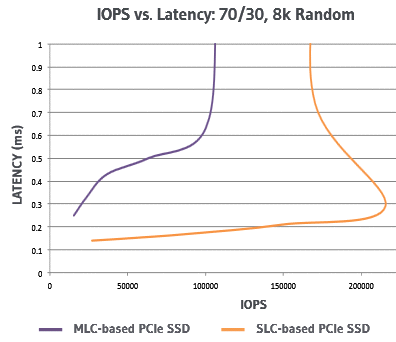 |
This paper presents Diablo's perspective - as
the creator of
Memory Channel
Storage (an architecture which supports terabyte class flash SSDs in
unmodifed DDR-3 DRAM DIMM sockets and runs within those safe operating
electrical power envelopes).
The article looks at the measured
performance weaknesses of some specific (but unnamed)
PCIe SSDs with respect
to their measured performance
asymmetries
under various loads and then attempts to generalize those weaknesses as part
of an argument that MCS is a better solution than PCIe SSDs - because MCS is
more scalabe and doesn't suffer from the same kind of architectural
bottlenecks.
Editor's
comments:- This paper from Diablo reminds me of the type of comparisons
between different types of PCIe SSDs (and their sensitivities to different
workloads) which was one of the pivotal marketing points of difference which
Virident used to
hang their reputation on in the years leading up to its acquisition by
HGST. (Although as I
often reminded readers at the time - Virident wasn't the only company with that
kind of array scalability or no-compromise performance.)
Going back to
Diablo's white paper - for me - like many vendors written papers - it's good and
bad in different parts.
The best bit is the middle - in which you get
a reminder - from measured results that fast SSDs with similar capacities
can behave
differently.
The worst part in my view is the attempt to link
these comparison results to a general conclusion about the merits of MCS
versus PCIe SSDs.
Because I think the architecture of the
controllers on the
flash side of the SSDs plays such an important part as too does the
software. And that's
still just a small part of the picture.
My considered view is that
Diablo's extrapolation towards a general market conclusion from one
selected comparison example is not merited by the evidence presented in this
article.
And while I am convinced of the benefits of Diablo's MCS
architecture - and what it can do differently and better compared to PCIe SSDs
- I think this particular paper isn't the best case they could argue.
related
articles
| | |
|
. |
|
 |
|
. |
|
| Popular white papers and
PDFs in April 2014 |
Editor:- April 30, 2014 - I'm not a great fan
of PDFs - but there are some on the mouse site.
Here are some of the
most popular PDFs which StorageSearch.com readers have been seeing this month.
| | |
|
. |
|
 |
|
.
.
.
.
.
.
. |
|
 |
|
.
.
.
.
.
.
. |
|
"I think the WFA is the most significant new product direction for
Violin since the company switched away from using DRAM in its rackmount SSD
arrays - and over to using flash (in November 2008)." |
|
.
.
.
.
.
.
.
.
.
.
.
.
.
.
.
.
.
.
.
. |
|
| Decloaking hidden segments
in the enterprise |
Editor:- May 28, 2014 - StorageSearch.com today published
a new article -
Decloaking
hidden segments in the enterprise for rackmount SSDs
Some of the
world's leading SSD marketers have confided in me they know from
their own customer anecdotes that there are many segments for enterprise
flash arrays which aren't listed or even hinted at in standard models of
the enterprise market.
Many of these missing market segments don't
even have names.
Hey - that means SSD-world is like a map of the
US before Lewis and Clark.
If you're a
VC should this make
you anxious or happy?
If you're a user - maybe that's why no one is
delighting you in the way you think you deserve.
That's what led me to
write my new article.
See
also:- rackmount
SSDs, SSD silos,
market research | | |
|
.
.
.
.
.
..
.
.
.
..
.
. |
|
|
|
.
.
.
.
.
. |
|
 |
|
.
.
..
.
. |
|
 | |